Read an Extract from Agatha Raisin: Dead Before Teatime, M. C. Beaton with R. W. Green
Chapter One
‘They’re going to destroy Carsely! The whole village will be ruined, Bert!’ the woman dabbed her eyes with a tissue,
then blew her nose with a blast so loud that it might have been mistaken for a passing train, had Carsely been anywhere near a railway line. ‘They can’t do this to us! Somebody has to stop those . . . those . . . bastards!’
The woman stomped down the two steps from the door of the Red Lion pub and hurried along the pavement.
She had white hair drawn back into a neat bun and the solid, healthy stature of a woman who had been
born, bred and lived a lifetime in the English countryside. Her husband, not quite as tall nor quite as robust was, nonetheless, her equal in his indignation.
‘Something will be done, Doris,’ he said sternly. ‘They’ll not get away with it, you mark my words. Devils like them have been murdered for less than this!’
Agatha Raisin was crossing the high street from her home in Lilac Lane, with her former husband and current next-door neighbour, James Lacey, at her side. Having long since realised that they preferred to rely on each other as friends and confidantes rather than live together as husband and wife, the divorced couple were now far more relaxed in each other’s company. This being an unusually warm autumn evening, they’d decided to take a stroll down to the Red Lion for a bite to eat in the pub garden. Agatha immediately recognised the pair who had just left the pub. Doris Simpson was Agatha’s cleaner, showing up at her cottage each Tuesday morning as regular as clockwork to vacuum, dust, polish and scrub – all the jobs Agatha found too tediously time consuming and Doris did far better. Doris’s husband Bert was occasionally coerced into cleaning Agatha’s windows. She had never seen the normally placid Simpsons so upset.
‘Whatever’s the matter, Doris?’ Agatha said when they drew nearer. ‘What’s happened?’
‘Oh, Mrs Raisin,’ Doris said, pulling herself together with a flush of embarrassment at having been caught in such a state. ‘It’s just awful! Part of our village . . . part of our lives . . .’ Her lower lip trembled and she waved a hand in front of her face to shoo away distressing thoughts. ‘I . . . I’m sorry, I can’t talk. Come on, Bert, let’s get home.’
Agatha watched them hurry off down the high street, then turned towards the pub where she saw two men she recognised as Carsely villagers and Red Lion regulars leaving. The men shared grim expressions and grumbled words.
‘What was all that about?’ James said, standing with his hands on his hips, still watching the departing Simpsons. ‘Doris and Bert are usually so pleasant – always full of chat.’
‘And those two,’ Agatha said, indicating the two regulars now striding off along the pavement, ‘have never been known to leave their bar stools before closing time. Something’s up, James.’
She marched to the pub, determined to find out exactly what was going on, James catching up just in time to reach over her shoulder and push open the door. They were immediately hit by a wall of noise. There were no more than two dozen people in the place, two-thirds of them men, but they were laying siege to the bar, everyone talking at once, each a little louder than the next. Some pointed angry fingers at the woman behind the counter. The barmaid, Shona Macneil, stood with her arms folded, staring back at her outraged customers with a resigned expression that Agatha might have taken for boredom had she not spotted the way the fingers of Shona’s right hand were tapping her left arm. It looked like the countdown to an explosion.
‘Shona!’ Agatha called, elbowing her way through the crowd to the bar. ‘What’s all this about?’
Shona turned towards Agatha, looking relieved to see a potential ally in the room. She was in her late thirties with a pale, pretty face and an unruly mane of reddish-blonde hair, currently tied in a ponytail that reached halfway down her back. She’d worked as a cook and barmaid at the Red Lion since her husband, who had been a tenant farmer on Sir Charles Fraith’s Barfield Estate, had run off with the postman to start a new life in New Zealand.
‘It’s this, Mrs Raisin,’ Shona said, taking a printed sheet from a stack on the bar and pushing it towards Agatha. The sheet was headed ‘Drink Up’, below which was a short message from the landlord:
The pub closes for good at the end of the month.
Shona’s in charge.
No bar tabs, no credit, no freebies.
John
‘It’s succinct,’ James said.
‘It’s ridiculous!’ Agatha snapped, looking to Shona. ‘Where is he?’
‘John?’ she replied. ‘He’s gone.’
‘“Gone”? What do you mean, “Gone”?’ Agatha demanded. ‘Where has he gone?’
‘John and his wife—’ Shona began before being drowned out by a fresh wave of ranting from the regulars.
‘Would you all mind holding the noise down a bit, please?’ James said, turning to the complaining crowd and patting the air in front of him as a calming gesture.They ignored him.
‘That’s not the way to do it, James,’ Agatha said, reaching across the bar to grab the heavy brass hand bell normally used to call time at the end of an evening. She swung the bell up and down in the air like a hammer, creating a din that made the glasses tremble in their hanging racks above the bar.
‘QUIET!!!’ she roared, and suddenly there was silence. ‘We’ll achieve nothing by shouting!’ she asserted,
conveniently ignoring the fact that she’d achieved the desired silence by shouting louder than anyone else. ‘Let me find out what’s going on here.’
There came a few murmurs of approval as everyone took their seats. Although their anger rumbled on in grunts and whispers, no one, no matter how disgruntled, was willing to raise a voice and risk the wrath of Agatha Raisin. She laid the bell on its side on the bar and it lolled a little to the left as though exhausted by the clamour it had been forced to create.
‘So, where has John gone, Shona?’ she asked again, then shook her head. ‘No, never mind that for the moment. Start from the beginning. Why is the pub closing? What the hell’s happened?’
‘The first I knew was when John came in this morning and told me he’d pay me two months’ wages if I kept the place going until the end of this month,’ Shona explained. ‘Apparently, he’s been arguing with the brewery for weeks. He was a tenant here, you see. The brewery – Ancombe Ales – actually owns the place. When the lease came up for renewal, the brewery hiked the price up so high that John knew he’d never be able to pay it.’
‘What was the point in that?’ Agatha asked. ‘If John couldn’t make enough from running the pub to pay the lease, then surely no one else can either. They’ll never find another tenant. They’ve killed the business stone dead!’
‘Seems that’s exactly what they wanted to do,’ Shona continued. ‘The brewery’s owned by Lord Ancombe. He also owns Ancombe Developments. They have plans to extend the building out into the garden, build an entire new wing and turn the whole thing into luxury apartments.’
‘They want to do away with the Red Lion altogether?’ James was appalled. ‘That’s madness!’
‘Shameful,’ Agatha said, shaking her head, ‘but not complete madness. Someone working for Lord Ancombe has sat down with a calculator and worked out that they can make a short-term profit from redeveloping the building – probably more money than they would make in years from this place as a pub.’
‘You’re only seeing this as a businesswoman,’ James argued, standing tall and squaring his shoulders, every inch the former army officer. ‘But strategically, the plan is fatally flawed. Carsely is a typical Cotswolds village. It’s a lovely place to live – desirable. It might seem like an ideal place to build expensive luxury accommodation, but what the brewery wants to do will change the very character of the village. They will then find their over-priced apartments extremely difficult to sell because without the pub, this is no longer such a desirable place. The pub is the very heart of a village like Carsely!’
‘I’d argue that the church is the very heart of the village,’ said Margaret Bloxby, the vicar’s wife, approaching the bar from the front door, ‘but I suppose we’d have a bigger congregation if we served beer in the transept.’
‘Mrs Bloxby!’ Agatha beamed at her friend, using the form of address preferred by the Carsely Ladies Society. It amused them to do so in public, although in private they were simply Agatha and Margaret. ‘We don’t often see you in here.’
‘Good evening, Mrs Raisin,’ Margaret said, returning the smile. Agatha had always thought that, when Margaret smiled, which was often, she seemed to radiate peace and happiness. She was transformed from an anonymous, petite woman with plain, grey-streaked brown hair into the centre of attention at any gathering.
‘I heard there was a riot brewing. What’s happening?’
Agatha explained the situation, the burble of conversation in the pub now having subsided completely. Everyone’s attention was focused on the two women.
One was a hugely respected, caring figure deeply involved with the local community; the other was Agatha
Raisin. The vicar’s wife and the uncompromising businesswoman who ran her own detective agency made a formidable team. Surely between them they could come up with a way to save Carsely’s beloved Red Lion?
‘We should start a petition,’ Margaret said, addressing all those in the bar. ‘If we get everyone in the area to sign it, we can present it to the council before they even begin considering any planning application to turn this place into apartments.’
‘Good idea,’ James agreed. ‘We’ll strike first! The petition will be a show of strength and present a united front. We’ll send the petition to Ancombe Ales as well. That will let them know we mean business and they have to take us seriously!’
There were mutters of approval and nods of agreement from everyone in the room, except one.
‘No, it won’t,’ Agatha said, frowning and shaking her head.
‘What do you mean?’ asked James.
‘No one at the council or at the brewery will give a toss about a petition,’ Agatha replied.
‘How do you know?’ Margaret asked.
‘Because I wouldn’t,’ Agatha assured them. ‘If I worked at the council or at Ancombe Ales, any petition that landed on my desk would go from my in-tray to my waste basket quicker than you can say “recycle”. Do any of you read the news? Almost four hundred pubs across Britain will shut down this year. The companies that own them cut them dead as soon as they’re no longer making enough money.
‘Ancombe Ales will be no different to any other big business. Their job is to maximise profits for their shareholders and his high-and-mighty lordship. If that means ditching a rural pub like the Red Lion, they won’t give it a second thought!
‘Saving our pub won’t be a priority for anyone at the local council, either. Our council is just like any other in the country. There’s a housing shortage and the government has given them a target to meet for creating new homes. Their biggest priority is to build places for people to live. They’ll be more than happy to fast-track a planning application and get one step closer to that housing target.’
‘So what are you saying, Mrs Raisin?’ Margaret asked, a mischievous glint in her eyes. She’d been in several tricky situations with Agatha in the past, the pair even having faced down a gunman together, and she knew that just the gentlest of nudges would launch her friend into attack mode. ‘Are you suggesting we give up without a fight?’
‘Hell, no!’ Agatha barked, the mere thought that she might have given anyone that impression lighting the short fuse on her temper. ‘I’ve never backed down from a fight in my life! The petition’s not actually a bad idea. Ancombe Ales and the council will be expecting a protest and some kind of petition, so we should give them what they’re expecting. They’ll then think we’ve done our best and run out of ideas, but we’ll be looking at all sorts of other ways to get the better of them!
‘Our first real move has to be to find out who we’re up against. I’ll have my detectives all over this first thing tomorrow morning. We need to know who will be handling this at the local council but most of all we need to target Ancombe Ales and Lord Ancombe himself.
We need to know our enemy. We need to know their strengths and weaknesses and find every weapon we can use against them! We’re going to fight Ancombe Ales – and we’re going to win!’
She slammed her fist down on the bar, causing the heavy bell to roll over the edge, dropping onto her foot with loud clang. Everyone in the pub held their breath, waiting expectantly, just as she was, for the wave of pain to travel from her big toe all the way up to her brain. Agatha set her jaw and announced through clenched teeth, ‘Drinks are on me!’
A cheer went up and in the ensuing rush to the bar, no one noticed her turning to grip the counter and letting out a faint whimper.
‘That must have hurt,’ Margaret said, picking up the bell and standing it back on the bar.
‘More than you know,’ Agatha confirmed. ‘I had a very expensive pedicure at lunchtime and that bell will have chipped the shellac off at least two toes.’
‘That was a truly rousing declaration of war,’ James said, squeezing through the crowd towards them. ‘You’ve got everyone behind you, Agatha.’
‘Good, because I meant what I said,’ she replied. ‘Tomorrow we go into battle, but right now . . . would someone please get me a gin and tonic?’
She walked over to a table by the window, trying not to limp.
The following morning, a dark blue Bentley saloon cruised south on the A429 out of Cirencester, wafting its occupants past miles of fields, trees and hedgerows.
While the harvest was well underway, with bales of hay in the fields either rolled like giant golden roulades or stacked like massive building blocks, the trees and hedgerows were stubbornly clinging to their green foliage. Soon they would begin to take on the red, orange and ochre of their autumn mantle and before long the first storms of the season would combine with the first of the frosts to bring the leaves tumbling to the ground.
In the back of the car sat two men, one in his mid-fifties with a heavily jowled, florid face and a waistline that strained the fabric of his white shirt. He wore a dark blue tie with white polka dots and was deeply engrossed in that morning’s Daily Telegraph. The man sitting next to him was around fifteen years younger with red hair and a thin, pale face that had clearly seen none of that summer’s sunshine. He, too, wore a white shirt, although his was open at the neck, without a tie.
‘So, Francis,’ said the older man, folding his newspaper and slapping it on the seat between them, ‘what can we expect from this yokel we’re going to see? Will he accept our offer for his land or will he hold out for more cash?’
‘He’ll fold,’ the red-haired man said, picking up an iPad and flicking the screen to show his fellow passenger some figures. ‘He’s in no position to bargain. He runs the farm with his son, Kevin. His wife died three years ago. He’s deep in debt to a whole range of suppliers, the majority of them controlled by us. The joke is that most of what we offer him for his land will come back to us through those companies.’
‘And the planning permission’s in the bag?’
‘The local council will play along. We have friends there.’ Francis seemed relaxed and confident to the point of apparent boredom.
‘Excellent. What’s the latest on our costs?’
‘The patch of land we’re talking about is roughly ten acres, with direct access from the main road. It’s a big enough plot for us to build fifty executive homes. Buying and building will set us back almost twenty million but each house will sell for at least eight hundred thousand –
we’ll take forty million.’
‘So we stand to make at least twenty.’
‘Well, obviously that won’t be clear profit, but—’
‘But every penny we can wring out of our poor little farmer pushes our profits higher. My sources say he’s got a dodgy ticker and is desperate to make a deal before the stress sends him to an early grave.’
‘Good – I’ll let you pour the pressure on him and I’ll back you up with whatever bullshit figures you need.’
The younger man glanced out of the window at the passing farmland. ‘Kemble station is close by and it’s just over an hour to London by train. It’s an expensive commute but the trend is still for people to work more from home, so most won’t be going into a London office every day. There will be plenty of buyer interest as soon as the development is announced. We’ll sell most of the units off-plan. Can’t say I’d want to buy a house out here, though. Nothing much to interest me.’
‘Nonsense, Francis!’ The older man laughed. ‘This is a wonderful part of the country. We’ve just passed the springs that are the source of the mighty River Thames and Malmesbury’s just up ahead.’
‘What’s in Malmesbury?
‘You don’t know Malmesbury? You need to soak up a bit of history while we’re here, my boy. Malmesbury was once England’s capital – way before London – and King Athelstan was the first king of all England. He was buried at Malmesbury Abbey and . . .’ He paused and looked
to the driver. ‘How are we doing for time, Stephen?’
‘Traffic has been light, sir,’ the driver replied. ‘We should get to the farm a few minutes early.’
‘Well, we can’t have that!’ his passenger said, laughing again. ‘We need to be late, not early. We’ll let our old farmer worry a while before we have our little chat. Stay on this road, Stephen, until we get to the roundabout just after the filling station, then follow the signs for the town centre.’
‘We’re going into Malmesbury?’ asked Francis.
‘Well, why not?’ replied the older man. ‘This is a chance for you to learn a little about England’s heritage. We’ll drive past The Birdcage—’
‘The what?’
‘Malmesbury Market Cross. It’s a kind of shelter for the market traders but it’s been around since the fifteenth century – probably built using stone from the abbey after part of it collapsed. Then there’s the abbey itself. You can still see bullet marks in the wall from the English Civil War.’
‘Ah, now I know why you were spouting all that stuff about history. You’re not interested in that,’ said Francis, smiling and nodding. ‘Now we’re on to your favourite subject – the Civil War. You’re in danger of becoming obsessed by it.’
‘No danger – it is absolutely my obsession! The Civil War was an utterly fascinating struggle for land, riches and power. We can all learn a great deal from the way men of wealth and influence chose sides during that war, Francis. Some gambled everything on a dream of greatness while others indulged in the most cunning and ruthless skulduggery to hang on to their fortunes.’
‘Sounds a lot like modern business.’
‘Except without the Civil War’s horror and bloodshed,’ the older man said with a sigh. ‘Malmesbury saw some ferocious battles. There was fighting right outside the Old Bell Hotel. It’s still there – England’s oldest hotel. I had the most delicious curried lamb Scotch egg there not so long ago. We’ll reserve a table there for lunch after we’re finished with our farming friend. Stop outside the Old Bell, Stephen,’ he went on, raising his voice for the driver. ‘Then you can pop in and book a table for us.’
‘Of course, Lord Ancombe,’ the driver replied with a nod.
Agatha strode into the main office area of Raisin Investigations, closing the door behind her with a flick
of her wrist.
‘Catch-up meeting in—’ she began, only to be interrupted by Simon Black.
‘Your office in ten minutes!’ he said, finishing the sentence for her and treating her to one of his widest grins.
Agatha paused. Having anyone talk over her like that was distinctly irritating. For a member of her own staff to do it would normally be totally unacceptable, yet she had arrived at the office in a buoyant mood and refused to lose that feeling just because of Simon. She looked him up and down. He had a pointed nose, a pointed chin and wore pointed shoes. In between the chin and the shoes were a suit jacket that failed to cover his backside and trousers that failed to reach his ankles. Agatha was prepared to accept that, while she saw it as bordering on the ridiculous, the cut of his suit was fashionable for young men nowadays. She could not, however, tolerate his tie, which appeared to show an alien creature with an unfeasibly elongated head drooling more slime than a hungry St Bernard. She froze him with a cold stare until his grin faded.
‘Simon, you have a meeting with Mircester Insurance later this morning,’ she said.
‘Umm . . . yes, Boss,’ he agreed, staring down at the sharp toes of his shoes.
‘Change that hideous tie,’ she said, then marched towards the door of her own, private office, nodding brief greetings to Toni Gilmour, her second-in-command, and retired police officer Patrick Mulligan, both of whom were sitting at their desks concentrating on their computer screens.
Following her usual routine, Agatha skipped round the over-large desk that took up the majority of the floorspace in her small office and dropped her handbag into one of its cavernous drawers. She sat down and looked up, expecting to see her secretary and office angel, Helen Freedman, appear with a cup of coffee for her along with an armful of documents and that morning’s edition of the Mircester Telegraph. She wasn’t disappointed.
‘Just a few things for your attention this morning, Mrs Raisin,’ Helen said, carefully guiding the china coffee cup and its saucer to their usual position on the desk.
‘The ones with the red tags need your signature.’
Agatha thanked her and a movement caught her eye through the window that looked out into the main office. Simon was gyrating his hips and waving his tie above his head, grinning and chanting ‘The Stripper’ tune at a volume he probably thought was too low for her to hear. Toni threw a scrunched-up ball of paper at him, laughing. Patrick allowed himself one of his rare smiles. Agatha reached for her coffee. Simon was irrepressible and, as he had proved many times, very good at his job. It was impossible not to like him and she valued the youthful energy he and Toni brought to the office.
That, of course, Agatha mused, was not to say that she was lacking in energy in any way herself. Being a little more mature simply meant that she could contain her vigour until it was needed. She could channel it in a useful way. Larking around was a waste of energy but she understood that young people needed to let off steam. She didn’t envy their carefree exuberance at all.
‘No,’ she said softly to her coffee before taking a sip, ‘not at all.’
By the time she’d returned the cup to its saucer, she knew she was lying to herself . . . and the cup. Of course she envied them their youth, but that was natural, wasn’t it? There was nothing wrong with that – but did that make her feel old? Well, that was a discussion she could have with a later coffee. Right now, she had more important things to think about. She began flicking through the local paper. Although she knew she could read all of the main stories on the newspaper’s website, there were often little nuggets of information in the printed version that didn’t make it to the computer screen.
There was, for example, a small piece about the council inviting tenders for the provision of a new limousine for the mayor. She’d known that was going to happen because the mechanic who looked after the current mayoral car also serviced her own car. He loved to chat and was a wellspring of revelations, gossiping indiscreetly about his clients. Agatha was always careful to exchange only the most innocuous morsels in return. He had told her that the mayor’s old Daimler needed a small fortune spent on it to keep it roadworthy. He had reckoned the council would soon buy a new vehicle. Now the tendering notice was demanding a car ‘that properly reflects the mayor’s status and projects a prestigious image at official meetings and events’. Her mechanic had been right.
This particular story was of no apparent use to her in any of Raisin Investigations’ current cases, but Agatha firmly believed that storing titbits of information somewhere in her memory banks was one of the things that helped make her a good detective. Knowledge was power, and even the most insignificant stories could sometimes prove to be absolute gems, providing links that brought unrelated facts together to form solid clues. The local paper was a treasure trove of such gems.
She was refolding the newspaper, reminding herself that she needed to talk to her mechanic about her car door sticking shut, when she spotted an advertisement for a dinner dance at a local hotel. There was an illustration of a couple waltzing across a ballroom floor with a dance band in the background. Her first thought was that she should tell John. It was exactly the sort of event they loved – dancing the night away together. Then she stopped, dropped the paper on her desk and rested her chin in her hands. She couldn’t tell John. John was gone, taken from her by a heart problem no one knew he had. Finding him sitting in the dance studio he had built in his back garden, waiting for her, had been the saddest day of her life. She looked again at the image of the dancing couple. Those had been the happiest of times. She needed to concentrate on that. Treasure the happy memories and banish the sad thoughts. There were far more happy memories. They would always win out in the end, wouldn’t they?
Toni knocked on her door and poked her head into the room.
‘Ready for us now?’ she asked.
‘Of course,’ Agatha replied. ‘Always ready for business.’
‘I love that dress,’ Toni said, dragging a chair into the room. ‘I could never get away with that. I just don’t have the figure.’
Agatha brushed an imagined speck of dust off the three-quarter-length sleeve of her deep green shirt dress.
It had taken her a while to decide on this particular outfit that morning. Now the days were no longer promising the heat of a summer sun, but had yet to submit to the chill of winter, the calf-length dress, belted at the waist, had been the optimum choice. A stylish yet practical compromise between her summer and winter wardrobes.
As Toni had pointed out, it also showed off her curves to their best advantage, the belt helping to disguise the inch or so that had somehow crept on to her waist over the last few weeks. Having your body play evil tricks like that, Agatha thought to herself, was not something Toni needed to worry about. She was slim and beautiful, with blonde hair, blue eyes and scarcely a trace of make-up.
They had once been out on a job together when someone had mistaken Toni for her daughter. Agatha had been appalled. She was loath to admit that she looked old enough to be Toni’s mother but, given how pretty Toni was, whenever anyone had subsequently made the same mistake, Agatha had persuaded herself she should take it as a compliment.
‘Never mind, Toni,’ she said sympathetically, smoothing the dress at her waist. ‘There’s an art to looking this good. You’ll learn.’
Toni was followed by Patrick and Simon, who settled into the chairs they’d brought, Patrick slipping a sheaf of notes on to the desk along with his coffee mug.
‘Right,’ Agatha said, ‘let’s go through everything before I get on to something new that needs our attention. Toni, what’s happening with our two divorce cases?’
‘Mrs Tweedy was growing a bit impatient, starting to think that she was wrong in suspecting her husband of having an affair,’ Toni said.
‘She was convinced that something was going on when she came in here asking for evidence she could use to divorce him,’ Agatha pointed out.
‘I think Mr Tweedy might have been sweet-talking her,’ Toni said. ‘I’m pretty sure she now wants to make a go of the marriage. She was quite short with me on the phone. A bit rude really . . .’
‘She’s paying for us to provide a full report from our surveillance, Toni,’ Agatha said, listening to Toni’s hesitation. ‘The photographs you got of him with his secretary are cast iron. It’s not our job to hold anything back in order to spare her feelings. She needs to know the truth. What she does about it is her business.’
‘I know,’ Toni said with a sigh. ‘I’ve arranged to visit her this afternoon.’
‘Good,’ Agatha said. ‘I’ll come with you. She may have had a change of heart, but I don’t want her thinking she can squirm out of our contract. We still need to be paid. What about the other case?’
‘Ah, yes,’ Toni said, ‘Mr Framley. He’s away a lot on business and thinks his wife is cheating on him when he’s not home.’
‘Why does he think that?’ Agatha asked.
‘I’m not sure yet. He’s coming in to see me tomorrow,’ Toni said. ‘I’ll know more then.’
‘Sounds like one you can handle,’ Agatha said, ‘but keep me informed. Simon, what more do you have for us on the Mircester Insurance enquiry?’
‘I should find out a lot more about it all at today’s meeting,’ Simon answered, pulling his phone from his jacket pocket and flicking his thumb across it. ‘All I know for now is that Delilah, Arabella and Scarlett have gone missing.’
‘A missing persons job?’ Agatha frowned, felt a wrinkle forming and immediately unfrowned. ‘How does that involve the area’s biggest insurance company?’
‘Because the missing ladies in question are not persons,’ Simon said, grinning and holding up his phone to show them a series of photographs. ‘Delilah is a 1963 E-type Jaguar worth almost two hundred thousand pounds. Arabella is a Mercedes SLR McLaren roadster valued at six hundred thousand pounds and Scarlett is a 1959 Ferrari 250 GT that would set you back at least six million.’
‘For a car?’ Toni was astounded.
‘Absolute classics,’ came Patrick’s gravelly voice. ‘Works of art, you might say.’
‘Why give them names?’ Agatha asked.
‘Don’t we all have names for our cars?’ Simon asked, looking round at them all, clearly enjoying himself.
‘Only when I can’t get the door to open,’ Agatha said, ‘and I wouldn’t want to repeat those names here. So – these cars have been stolen?’
‘That’s what the owner says,’ Simon confirmed. ‘Mircester Insurance will be briefing me on how we could be involved and what they’d want us to do.’
‘Fine – that’s another one I want to be in on, Simon, at least for that initial meeting,’ Agatha said. Simon shrugged and nodded, clearly disappointed that he wasn’t to be going it alone. Agatha knew his ego would be bruised. He wouldn’t want his contacts at Mircester Insurance to think she was ‘babysitting’ him. ‘You’ll be running the case, whatever it turns out to be,’ she assured him, ‘but I want the insurance people to know that we’re fully committed, given how much money seems to be involved. Patrick, where are we with our solicitor friends?’
‘We had a stack of legal papers they asked us to serve on various individuals,’ Patrick reported. ‘I’ve dealt with four of them. Of the remaining six, three should be straightforward but the other targets are being elusive.’
‘Keep on it, Patrick,’ Agatha said. ‘You’ll track them all down. So – anything else?’
‘Just Mr Tinkler from downstairs,’ Toni said. ‘He caught me on the way into the office this morning and asked if you could pop in to see him. He seemed a bit concerned.’
Mr Tinkler owned the antiques shop below the Raisin Investigations office. He was polite, a little reserved, undoubtedly eccentric, occasionally exasperating, and a good friend.
‘I’ll go down for a chat as soon as we’re finished here,’ Agatha said. ‘Now, I need your full attention, because this is important. This is something that could make me very unhappy, and none of us want that, do we?’
The other three glanced at each other and looked back at Agatha shaking their heads.
‘We have a fight on our hands,’ she said, clenching her fist as if she were about to pound the desk, although she stopped herself when the memory of the bell made her big toe throb. ‘Yesterday evening I learned that my local pub is closing down and we’re going to stop that happening! We’re going to save the Red Lion!’
‘Saving a pub! Cool!’ Simon said, rubbing his hands together, obviously imagining a hero’s welcome of free drinks at the bar.
Agatha explained the situation with Ancombe Ales and the redevelopment plan.
‘We have to carry on here with business as usual,’ Agatha said, ‘but I also want you all thinking about Ancombe Ales and the council planners. Toni, are you still in touch with Edward Carstairs from the Mircester Naturist Society?’
‘Yes, we’re . . . I mean, I . . . I saw him at the club on Saturday,’ Toni said before Simon broke in.
‘At the nudist club?’ he laughed. ‘Seeing quite a lot of him then, if he’s still hanging out—’
‘Simon,’ Agatha said with an exasperated hiss, ‘you made those jokes when we were investigating at the club. They weren’t funny then and they haven’t improved. Toni, Edward works at Mircester Council, doesn’t he? We need to find out who will be handling the Red Lion planning application. Maybe he can help.
‘Simon, you went undercover at the Watermill Brewery when their accountant was lining her pockets. You must still have some contacts there. See what you can find out from them about Ancombe Ales – suppliers, transport, customers, everything you can. Patrick, last night I was told Ancombe Ales is run by Lord Ancombe. I want as much background as you can get me on him, his family and his management team.’
‘Maybe the best person to tell us all about his lordship would be your . . . um . . . friend . . .’ Patrick began, then hesitated. He was never quite sure how Agatha would react when Sir Charles Fraith, her former lover, was mentioned, given that he managed to fall out of favour with her on such a regular basis.
‘If you mean Charles, you may be right, but I don’t want to involve him at the moment,’ Agatha said. ‘He’s never been good at keeping secrets and I don’t want the council or Ancombe knowing we’re snooping around just yet. Keep your enquiries subtle and only talk to people you trust. We need to know all we can about who we’re up against. I want you to dig up whatever dirt you can – anything we can use against these people if we’re to save the Red Lion.’
‘Are you talking about blackmail?’ Patrick asked.
‘That’s a very nasty word, Patrick. We’re not lawbreakers and I don’t want us to get into anything criminal,’ Agatha assured him, ‘but the truth can hurt and if Ancombe or anyone else we’re up against has any nasty little secrets lurking in the background, then I want to know. If we need to, we can use the truth to bring them down.
‘You all know what you need to do, so get on with it. I’ll deal with this paperwork then go down to see Tristan Tinkler.’ Her three colleagues began filing out of her office with Simon the last to leave. ‘Simon, don’t leave for Mircester Insurance without me.’
‘Wouldn’t dream of it, Boss,’ he said, turning to flash her another wide smile.
‘The tie’s much better,’ she said, looking down to study the documents on her desk, ‘but you’ll never make a Chippendale.’
Enjoyed chapter one? Find out more:
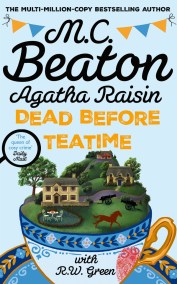
Agatha Raisin: Dead Before Teatime
by M.C. Beaton
by R W Green
The brand new village mystery starring Agatha Raisin!
Agatha Raisin's Cotswolds village of Carsely is in uproar when word spreads that The Red Lion pub is preparing to close. The aristocratic owner of the local brewery plans to develop the land into luxury apartments.
Taking it upon herself to lead the petition against the closure, Agatha sees a perfect opportunity to confront redeveloper Lord Ancombe when she is invited to his annual Civil War re-enactment at Ancombe Manor.
Watching men ride around on horses with replica guns is far from Agatha's favourite pastime, so she is relieved to hear there will at least be afternoon tea. But before the scones can be served, Lord Ancombe is discovered shot dead.
Suddenly Agatha has not just a pub to save, but a murder to solve. It seems her investigations are not everyone's cup of tea . . . Agatha has the distinct impression that someone is trying to silence her, for good
Praise for the Agatha Raisin novels:
'A Beaton novel is like The Archers on speed' DAILY MAIL
'The detective novels of M C Beaton have reached cult status' THE TIMES
'Agatha is like Miss Marple with a drinking problem, a pack-a-day habit and major man lust. In fact, I think she could be living my dream life' ENTERTAINMENT WEEKLY
Related Posts

Win an Agatha Raisin: Sugar and Spite prize bundle including tote bag, tea towel and Bird & Blend Autumn Tea Selection with Agatha Raisin: Sugar and Spite
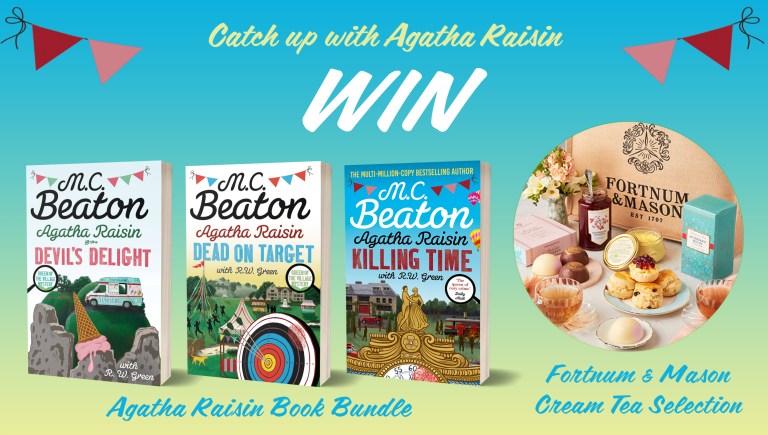
Win an Agatha Raisin Book Bundle PLUS a Fortnum & Mason Cream Tea Selection

Win a Hamish Macbeth 40th Anniversary Bundle
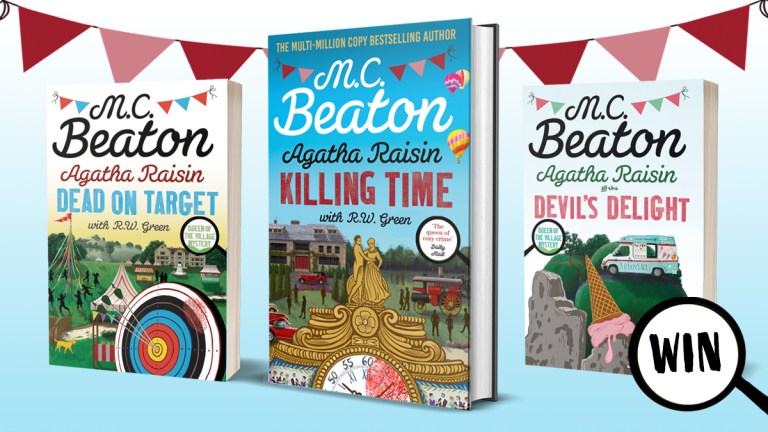
Win Agatha Raisin: Killing Time, Dead On Target, and Devil’s Delight
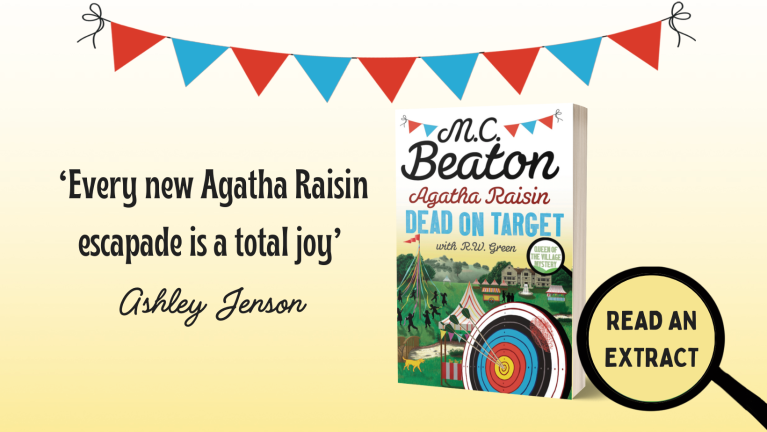
Read an Extract from Agatha Raisin: Dead on Target, by M. C. Beaton with R. W. Green